TWO:CHAPTER XXXVI. CRIMES OF DIFFICULT PROOF.The following letter by Beccaria to the Abb¨¦ Morellet in acknowledgment of the latter¡¯s translation of his treatise is perhaps the best introduction to the life and character of the author. The letter in question has been quoted by Villemain in proof of the debt owed by the Italian literature of the last century to that of France, but from the allusions therein contained to Hume and the ¡®Spectator¡¯ it is evident that something also was due to our own. Beccaria had spent eight years of his youth in the college of the Jesuits at Parma, with what sense of gratitude this letter will show. The following is a translation of the greater part of it:¡ª
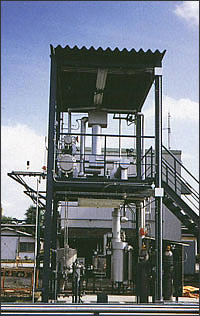
Great attention is recently being paid to global environmental issues, and it is now conceivable that companies will need to treat used solvents themselves. In consideration of this kind of social issue, we have developed a “membrane separation type solvent dehydration system,” which uses a polyimide membrane with superior dehydration properties developed by Ube Industries, Ltd. in combination with our own distillation and concentration technology that has resulted in solvents being more easily recovered.
THREE:Where there is no capital punishment, as in Michigan, a man¡¯s innocence may be discovered subsequently to conviction, and justice done to him for the error of the law. Such a case actually happened not long ago in Michigan, where a prisoner¡¯s innocence[41] was clearly proved after ten years¡¯ imprisonment. Where capital punishment exists, there is no such hope; nor is there any remedy if, as in the case of Lewis, who was hung in 1831, another man thirty-three years afterwards confesses himself the murderer. It is impossible to preclude all chances of such errors of justice. Illustrative of this is the story of the church organist near Kieff, who murdered a farmer with a pistol he stole from a priest. After his crime he placed the pistol in the sacristy, and then, when he had prevented the priest from giving evidence against him by the act of confession, went and denounced the priest as the culprit. The priest, in spite of his protestations of innocence, was sentenced to hard labour for life; and when, twenty years afterwards, the organist confessed his guilt on his deathbed, and the priest¡¯s liberation was applied for, it was found that he had died only a few months before.[26]CHAPTER IX. SECRET ACCUSATIONS.
- 1Under the distillation system, even in case of azeotropic solvent compositions, this system which remove water vapor by the polyimide membrane will easily dehydrate.
- 2In comparison with the distillation system, it significantly saves on use of steam.
- 3Dehydration can be performed through merely supplying evaporated vapor to the membrane module and maintaining the differential pressure between the permeable side and the impermeable side.
- 4Solvent purity of 99.9% or more can be achieved by carrying out dehydration with a polyimide membrane only.
- 5The polyimide membrane has superior heat and solvent resistance. Therefore, the vapor permeation system reduces contamination of the membrane and thus extends its life.
THREE: There remain two questions for me to examine: the first, whether asylums of refuge are just, and whether international agreements of extradition are expedient or not. There should be no spot within the boundaries of any country independent of the laws. Every citizen should be followed by their power, as every substance is followed by its shadow. There is only a difference of degree between impunity and the right of asylum; and as the effective influence of punishment consists more in its inevitability than in its violence, asylums do more to invite to crimes than punishments do to deter from them. The multiplication of asylums is the formation of so many petty sovereignties; for where there are no laws to command, there it is easy for new laws, opposed to the general laws of a country, to be formed, and consequently for a spirit opposed to that of the whole collective social body to arise. All history shows that from asylums have issued great revolutions in States and in the opinions of mankind.
The aromatic polyimide membrane is highly permeable to water vapor but less permeable to vapors of organic compounds such as alcohol etc.
THREE:CHAPTER XVI. CAPITAL PUNISHMENT.
- 1 Recovery of the detergent solvent Recovery of the cleaning solvent such as electronic parts industry, precision instrument industry.
- 2Solvent recovery and the refinement Solvent recovery and the refinement such as chemical industry, an industry of medical supplies, food industry, the fermentation industry.
THREE:Nor was it only in Europe that Beccaria¡¯s influence thus prevailed, for as soon as the American Colonies had shaken off their English connection they began to reform their penal laws. When the Revolution began there were in Pennsylvania nearly twenty crimes punishable by death, and within eighteen years of its close the penal code was thoroughly transformed, it being ordained in 1794 that no crime should any longer be capital but murder in the first degree. It is true that this was but a return to the principles adopted by Penn on the settlement of the colony, but Penn¡¯s penal code was annulled by Queen Anne, and the English Government insisted on a strict adherence to the charter from Charles II., which enjoined the retention of the Statute and the Common Law of England. When, therefore, the new Constitution was formed in 1776, the arguments of Beccaria gave fresh life to the memories of Penn.[25]
Acetone, ethanol, methyl ethyl ketone, butanol, isopropyl alcohol, ethyl acetate, methyl isobutyl ketone, others (including hexane and toluene).
